
Today, we use the words “left” and “right” to describe all kinds of contrasting, even opposing, ideas.
In social customs around gender, left and right can mark status and position. In politics, they can distinguish ideologies. In the way we use our hands, and in language itself, they can carry judgments about ability…
Consider the language: in English, “right” means both the right-hand side and what is correct or just. The word “dexterous” means skillful, and its roots lie in the Latin “dexter,” meaning right-sided1; “sinister,” meanwhile, comes from a Latin word for the left side2.
We find similar patterns in culture. In many communities, as in many Indian customs concerning the use of the hands, eating with the right hand is customary etiquette. The left hand is associated with personal hygiene and cleaning the body3. In some ancient Roman traditions of divination, even the interpretation of an omen appearing on the left depended on the direction the observer was facing4. But the history of a word is not a simple, straight line from “left” to “evil.”
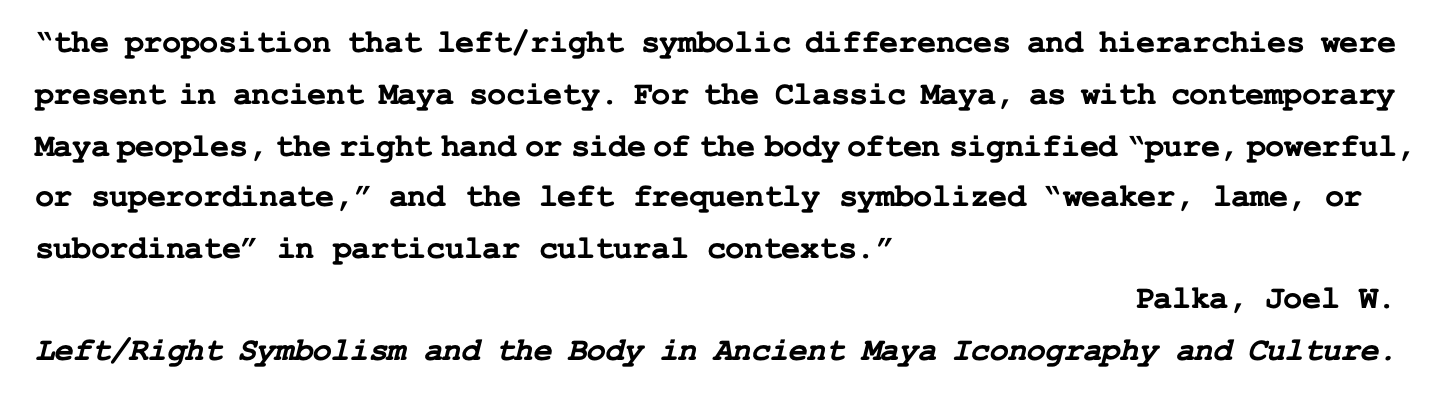
“For the Classic Maya, as for Maya people today, the right hand or the right side of the body generally symbolized ‘purity, strength, or dominance,’ while the left hand, in particular cultural contexts, often represented ‘weakness, lameness, or subordination.’”
A distinction between the two sides of the body thus entered the language of ability and morality, taking on meanings that reached beyond space itself.
Left and right began as directions. Why did some directions become something more?
In a different context, the anthropologist Todd Ramón Ochoa published a paper in 2010 titled Prendas-Ngangas-Enquisos: Turbulence and the Influence of the Dead in Cuban-Kongo Material Practice. It discusses Cuban-Kongo religious traditions in Havana. “Regla de Ocha” / “Lucumí,” often called “Santería,” is regarded as the “right hand” of African-derived religious traditions, associated with higher prestige, soothing, and improving relations among the living, the dead, and deities5. “Palo,” which has ties to Central African Kongo traditions, is called the “left hand.” It is associated with powers of danger, misfortune, and harm, and is feared as a result6.
This pattern, in which the right symbolizes what is legitimate and beneficial and the left what is dangerous and impure, resembles the idea of “the unequal status of the two hands” discussed in Robert Hertz’s The Pre-eminence of the Right Hand, although the societies and historical settings of the two studies differ.
Hertz argues that the distinction between left and right goes far beyond the physiological differences between the two sides of our bodies: it is deeply rooted in the collective consciousness of human cultures and religions7.
Start with a simple fact: our two hands, and the two sides of our bodies, do occupy different positions in space. But the move from “on the right” to “more correct, more orthodox” is not simply an extension of that natural fact.
In short, Hertz sees this as an expression of a fundamental dualism8. Dualism is a major feature of primitive thought and shapes the way certain societies are organized9.
Hertz is not simply asking why people divide things into A or B. He examines what classification means for the organization of social relations, and how social practices entrench these values. He stresses that the left hand is neglected not because it is inherently incapable, but because it is persistently constrained10. Some societies reinforce the right hand’s advantage through education, habit, and punishment, even preventing the left hand from developing independently. Sound familiar? (doge)
To my mind, difference does not necessarily imply hierarchy. It can become a hierarchy when different values are assigned to those differences and continually reinforced through social practice.
Directions need not carry values, but society can give them values
For Hertz, physiological factors merely provide an occasion for the right hand to be regarded as “nobler”; the underlying reason lies in religious polarity11. In some of the religious ideas he discusses, for example, the sacred and the profane, life and death, strength and weakness correspond to one another and find expression in rituals, bodies, and social relations.
I won’t explore that in depth here. To my mind, his concepts and ethnographic materials are bounded by geography and history, and need to be read in the context of early twentieth-century anthropology. His use of “primitive thought,” for example, has been criticized. For our purposes, it is enough to understand why people need binary classifications and how these affect social life.
Once a direction carries values, it is no longer just a direction
How did the political left and right come about? Today, we often think of the left as progressive and the right as conservative, but the reality is more complicated.
The terms “left” and “right” in modern politics are usually traced to the seating arrangements in the National Assembly during the French Revolution in 178912: representatives who supported limiting royal power sat to the presiding officer’s left, while those more inclined to retain it sat to the right13.
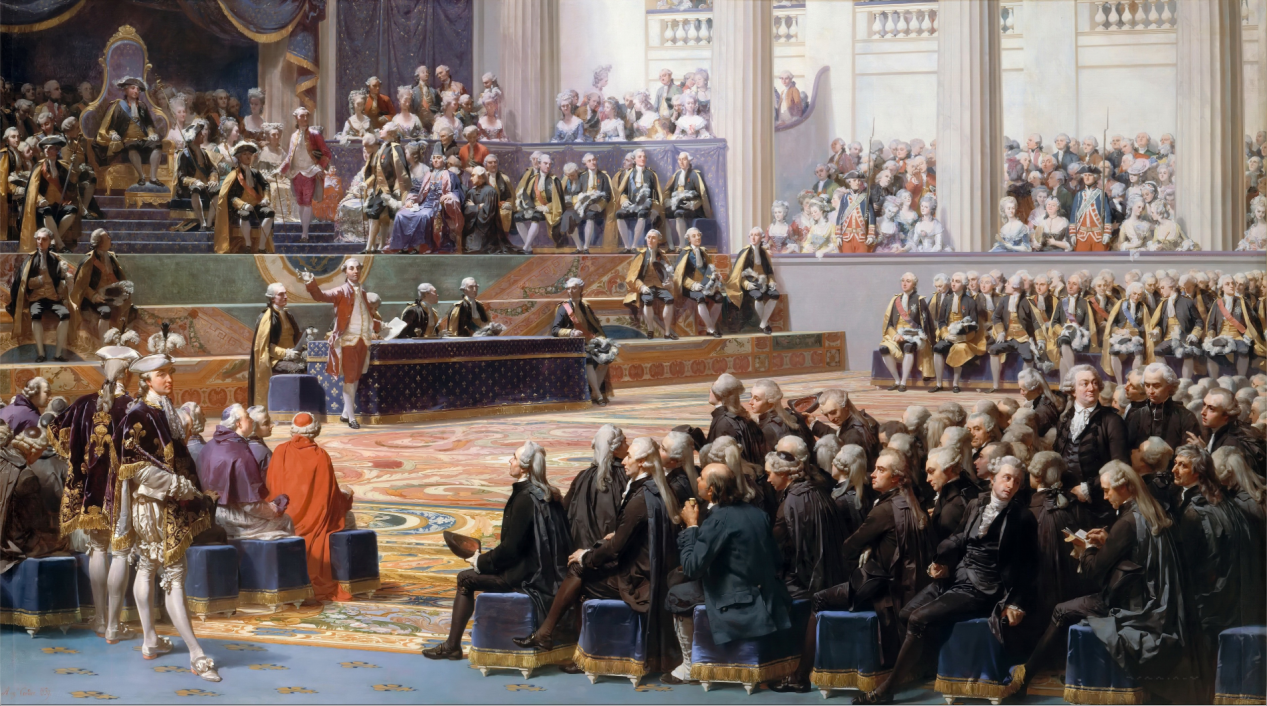
Through repeated use, what began as a concrete distinction between seats became an abstract political vocabulary. Today, people can discuss whether a policy belongs to the left or the right without having to place it on either side of a room.
As modern party politics and industrial society developed, left and right gradually became associated, in many European political settings, with issues such as capital and labor, social equality, the distribution of wealth, market mechanisms, and government intervention in the economy. These are broad descriptions, though. They do not apply to every country or every party, and they cannot replace an analysis of specific policies.

As labels, left and right help us make sense of complex political positions. They can also compress multidimensional views into two camps.
But compression means leaving things out. Someone might support certain economic reforms while taking a different position on cultural issues. Describing that person simply as “left” or “right” is a little too sweeping. When we classify someone as left-wing or right-wing, do we mistake that label for an understanding of everything they think? Once these categories become moral judgments, it becomes easy to treat a disagreement as a conflict between good people and bad people. That is something we must never do.
Are we really talking about the same left and right?
Left and right have not had fixed meanings since the day they came into use. They retain a degree of historical continuity while also absorbing new political issues, so we cannot understand them apart from a particular time and country14.
Today, political conflicts can no longer be understood through economic policy alone. Returning to the examples at the beginning, left and right can also carry no value judgment whatsoever. Driving on the left or the right, stage left and stage right, directions on a map: these distinctions can be nothing more than practical conventions or systems of reference.
Left and right do not inherently mean good and evil, advanced and backward, or radical and conservative. What is right or wrong, what is advanced or backward, who is good or bad: each question requires its own argument. These concepts do not naturally belong to the same set of oppositions. But when similar frameworks of classification repeatedly organize them through social practice, we can easily mistake them for things that follow the same logic.
When does classification limit our understanding?
Back in today’s public discussions, political labels are useful tools for understanding positions, but they are not reality itself. They can make us lose sight of the complexity of particular policies and individuals at any moment.
First, labels do not always align perfectly with actual policy positions. A study published in Public Opinion Quarterly in 2026 used experimental data from Canada to examine how voters use left–right labels. It found that voters’ ideological self-placement may not fully match their positions on specific policies. At the same time, when policy information is unavailable, they still use left–right labels to infer candidates’ positions15.

So I am not trying to prove that “left and right form a universal system of symbols.” Some uses of left and right do involve value judgments; some are historical accidents; others are simply neutral spatial conventions. Labels should not do our thinking for us.
Rather than imagine who someone is with too little information, we might ask a further question: between left and right, what have we actually learned about them? Can a directional label accurately sum up an entire person? Let us return to the specific claims and the arguments themselves.
A more “rational” political discussion has never meant doing away with either the left or the right. It means bringing back into view the complexity those labels obscure.
References
1. Oxford University Press. (n.d.-a). Dexterous. In Oxford Advanced Learner’s Dictionary. Retrieved October 14, 2026, from https://www.oxfordlearnersdictionaries.com/definition/english/dexterous
2. Oxford University Press. (n.d.-b). Sinister. In Oxford Advanced Learner’s Dictionary. Retrieved October 14, 2026, from https://www.oxfordlearnersdictionaries.com/definition/english/sinister
3. World Health Organization. (2009). WHO guidelines on hand hygiene in health care: First global patient safety challenge—Clean care is safer care. https://www.ncbi.nlm.nih.gov/books/NBK144013/
4. Contributors to Wikimedia projects. (2022, March 14). 1911 Encyclopædia Britannica/Augurs. Wikisource, the Free Online Library. https://en.wikisource.org/wiki/1911_Encyclop%C3%A6dia_Britannica/Augurs
5.6. Ochoa, T. R. (2010). Prendas-Ngangas-Enquisos: Turbulence and the influence of the dead in Cuban-Kongo Material Practice. Cultural Anthropology, 25(3), 387–420. https://doi.org/10.1111/j.1548-1360.2010.01065.x
7.8.10.11. Hertz, R. (2013). The pre-eminence of the right hand. Hau Journal of Ethnographic Theory, 3(2), 335–357. https://doi.org/10.14318/hau3.2.024
9. Durkheim, É., & Mauss, M. (1903). De quelques formes primitives de classification: Contribution à l'étude des représentations collectives. L'Année Sociologique, 6, 1–72 https://classiques.uqam.ca/classiques/mauss_marcel/oeuvres_2/oeuvres_2_01/classification_prim.html
12. Hodgson, G. M. (2018). The French Revolution and the original left. In Wrong turnings: How the left got lost (pp. 30–45). University of Chicago Press. https://doi.org/10.7208/chicago/9780226505916.003.0003
13. Andrews, E. (2016, October 6). Where did the terms “left wing” and “right wing” come from? HISTORY. https://www.history.com/articles/how-did-the-political-labels-left-wing-and-right-wing-originate
14. Jahn, D. (2023). The changing relevance and meaning of left and right in 34 party systems from 1945 to 2020. Comparative European Politics, 21, 308–332. https://doi.org/10.1057/s41295-022-00305-5
15. Lachance, S., & Treger, C. (2026). Thinking ideologically: The limited role of left and right labels as policy shortcuts. Public Opinion Quarterly, 90(3), 730–757. https://doi.org/10.1093/poq/nfag015
Leave a thought
Comments appear after review. Write in whichever language you feel most at home.
No public comments yet. There’s room for your thoughts.