
How many times have you cried simply because you were somewhere you were supposed to feel sad?
Are you truly afraid of death, or are you repeating a response you have learned to give?
In Tibet, the body of the dead is carried to a mountaintop and offered to the vultures, in a ceremony without coffin or funeral music.
The sight of a sky burial overturns our inherited ideas of how death ought to be met. Yet the shock itself is only a mood, an emotional response shaped by society and culture.
I am reminded of an essay I once read about sky burial. Its author argued that the real question is not why they handle death this way, but whether we have seriously considered how we ourselves will die.
The Illusion of Mourning
After exploring the relationships among individual existence, the self, anxiety, and death, Kierkegaard distinguishes two responses to mortality: mood and earnestness.
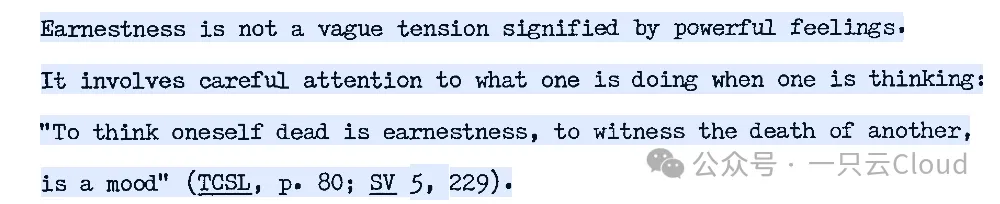
Freedom and Time in Kierkegaard’s The Concept of Anxiety
Humbert, David J.
For Kierkegaard, mood is something like our habitual response to death: an inauthentic feeling formed by internalizing society’s attitudes, whether fear, sorrow, or even indifference. We witness death defensively. At its heart lies an evasion: instead of confronting our own mortality, we passively accept other people’s ways of seeing it.
Earnestness, by contrast, is an inner awakening. It is the spiritual freedom we find when, recognizing that we too will die, we begin actively seeking what life means to us.
“Earnest” comes from the Old English eornost, meaning “ardent,” “sincere,” or “grave.” It is more than simply being serious. It means approaching something with authenticity, resolve, and a refusal of frivolity—especially life’s most essential questions, such as faith, morality, and death.
In this essay, it carries a sense of both authenticity and agency. Earnestness begins when we realize “I, too, will die,” and start asking, from the heart:
What does it really mean to be alive?
The Freedom of Dying
In the twentieth century, advances in public health and medicine extended life expectancy and improved living standards. Our fear of death began to give way to the joy of new life.
Today, public sympathy for private death has grown increasingly thin. Individuals are left to confront death and grief alone, to say goodbye in silence, rarely pausing to comprehend what the disappearance of a life really means.
In The Hour of Our Death, historian Philippe Ariès traces five stages in changing attitudes toward mortality: medieval “tamed death,” “one’s own death,” “the death of the other,” and the modern “forbidden” or “invisible death” (Ariès 5–6).
Sociologist Geoffrey Gorer goes so far as to compare private mourning to masturbation: it takes place in secrecy and, once exposed, must be covered with prudery (Gorer). Death has become a subject to be disposed of as quickly as possible.
But in a sky burial on the plateau, these “civilized” coverings seem to be torn apart along with the body. Death is no longer a private tragedy; it is returned to heaven and earth, naked and direct.
For many outsiders who come to witness it, this refusal to dress up death is too direct. The end of a life lies openly before us, and we feel unsettled. But where does the avoidance really lie? In death unveiled, or in our own fear of seeing it?
For devout Tibetans, sky burial is not mourning so much as release. They do not evade death, but accept life’s end earnestly and understand it as an offering back to nature and all living beings.
Death ceases to be merely a scene whose meaning society supplies—a mood—and becomes a genuine conversation between the individual and faith: earnestness.
I think we can only begin truly living when we earnestly face the fact that “I will die.” Then we can move forward through the loves and hatreds of the world with peace and freedom.
Work Cites
In order of appearance:
Kierkegaard, Søren. Fear and trembling/repetition. Vol. 6. Princeton University Press, 2013.
Chinese Social Sciences Library—The Ethics of Life: A Study of Kierkegaard’s Religious Existential Ethics, “Purpose and Structure of the Book.” www.sklib.cn/booklib/databasedetail?SiteID=122&Type=literature&ID=4752205&fromSubID=.
Humbert, David J. Freedom and Time in Kierkegaard’s The Concept of Anxiety. 1983, McMaster University, thesis, p. 45. McMaster Digital Repository, MacSphere.
Spitzenstätter, Daniel, and Tatjana Schnell. “Effects of Mortality Awareness on Attitudes Toward Dying and Death and Meaning in Life—a Randomized Controlled Trial.” Death Studies, vol. 46, no. 5, Aug. 2020, pp. 1219–33. https://doi.org/10.1080/07481187.2020.1808737.
Ariès, Philippe. The Hour of Our Death. Translated by Helen Weaver. New York: Alfred A. Knopf, 1981. 5-6.
Gorer, Geoffrey. Death, Grief, and Mourning. 1965.
Kierkegaard, Søren. Stages on Life’s Way. Translated by Howard V. Hong and Edna H. Hong, Princeton University Press, 1988.