
“Please don’t be so pessimistic.”
Borges ranged widely across philosophical schools and mystical religions, studying the Tao Te Ching, the Zhuangzi, and the I Ching in depth, and developing a distinctive view of life and death. Time looms large in his writing, as his celebrated “The Garden of Forking Paths” makes clear. And death—that “phantom on the horizon of time”—was naturally a subject he was bound to encounter as his writing ventured ever further.
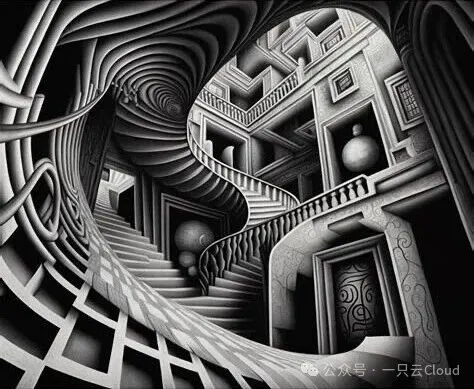
Surprisingly, Borges approached death with a certain openness. He imagined the universe as a great labyrinth containing smaller labyrinths, one after another; life and death were naturally among them. Someone happens to push open a door, walks through it, and never comes back. Perhaps that is all death is.
A fan once met Borges and, overwhelmed with excitement, blurted out, “You are immortal!” Borges replied, “Please don’t be so pessimistic” [15].
One could say that death tempted Borges throughout his life, while a sense of life’s meaninglessness haunted and troubled him. In his poetry and fiction, he returned repeatedly to death, describing suicide as a sublime act, the highest form of repudiating the body [16].
In one of his stories, the protagonist charges toward the soldiers in an almost suicidal act, affirming his destiny through a sublime form of self-negation. Yet Borges himself could hardly have expected to live almost to 90. When he was diagnosed with liver cancer in his final two years, his anxiety mysteriously disappeared. He longed for death, declined chemotherapy, and wanted nature to take its course.
Here his thinking resonates deeply with Zhuangzi at the most fundamental level: death is a transformation, rather than an ending.
As life begins, death begins; as death begins, life begins
This understanding of death as something that can be transcended offers a key to the similarities and differences between their visions of “life as a dream.”
If Zhuangzi’s butterfly dream contains the idea that life is a dream, Borges’s more explicitly narrative treatment inevitably contains it too. Yet in Borges’s retelling, the two visions both inherit from one another and diverge profoundly.
Zhuangzi uses the butterfly dream to suggest the unreality of fleeting life and the emptiness of all appearances, ultimately seeking a freedom that dissolves the distinction between self and things and forgets life and death. Borges, through his narrative labyrinths of dreams, conveys a distinctly modern bewilderment: individual understanding breaks down, and the foundations of existence begin to shake.
Beside Borges’s depictions of the dissolving self and the effort to apprehend existence, Zhuangzi’s parable carries a certain calm acceptance of life’s dreamlike unreality.
Their most subtle and decisive difference is this: through the “transformation of things,” Zhuangzi transcends the opposition between suffering and aspiration, reaching one of the summits of his philosophy. Borges uses the narrative of the dream to explore the limits of knowledge aesthetically. Zhuangzi’s concern is an ethics of life; Borges’s is ontology. What is the nature of existence? How is reality structured? Where does understanding end? These are the questions he draws from Zhuangzi and magnifies without limit.
A conversation
Yet Zhuangzi is renowned for doubting reality. He distrusts sensory experience and advocates relinquishing the senses altogether: “forget the liver and gall, leave behind the ears and eyes.”
The experiences we have in dreams are illusory; a reality likened to a dream is therefore illusory too. The “distinction” between Zhou and the butterfly depends on the act of distinguishing. Set aside discriminating knowledge and accept the dream, and one can leave behind bodily form and divisions without clinging to the difference between truth and illusion. Zhuangzi’s butterfly dream also carries the sorrow, helplessness, and bewilderment of being alive.
Borges, on the other hand, is an empiricist. He places his trust in sensory experience and regards an individual’s perceptions as the source of knowledge.
Although he repeatedly expressed his weariness with dialectical materialism, his understanding of life and death was largely materialist. In “Immortality,” he writes: “I hope my death will be complete. I hope my body and soul will die together. … I believe in immortality, not the immortality of the individual but that of the universe. We shall endure forever. When our bodies die, our memories remain; beyond our memories remain our actions, our deeds, our attitudes—all the finest things in the history of the world. We cannot know this, and perhaps it is better not to know.”
Perhaps that is why his writing so rarely lapses into sentimentality about life. He called himself a “hedonistic reader.” An individual life, the fate of a nation, the history of the entire world: perhaps, to him, they were simply books of different lengths.
Whether in Zhuangzi’s “free and easy wandering” or Borges’s dreams and realities, we are reminded that freedom resides in a state of mind, not in external things.
Amid the pressures and conflicts of modern life, we may never be entirely at ease in our own desires. Even so, in the gaps between dream and reality, we can glimpse an inward stillness and infinity.
Author’s note:
Work Cites
[15] “Taking the Novelist Borges Seriously: A Tireless Enthusiast of the Philosophy of Mind.” Douban Books, 19 Apr. 2008, https://m.douban.com/book/review/1357250/. Accessed 3 Nov. 2025.
[16] Borges, Jorge Luis. “Biografía de Tadeo Isidoro Cruz.” El Aleph, 1949.