
Once, Zhuang Zhou dreamed he was a butterfly, fluttering freely, perfectly content to be a butterfly. He knew nothing of Zhou. Suddenly he awoke and was unmistakably Zhou again. Yet he did not know whether Zhou had dreamed of being a butterfly, or a butterfly was dreaming of being Zhou. Between Zhou and the butterfly there must, after all, be a distinction. This is called the transformation of things.
—Zhuangzi, “Discussion on Making All Things Equal”
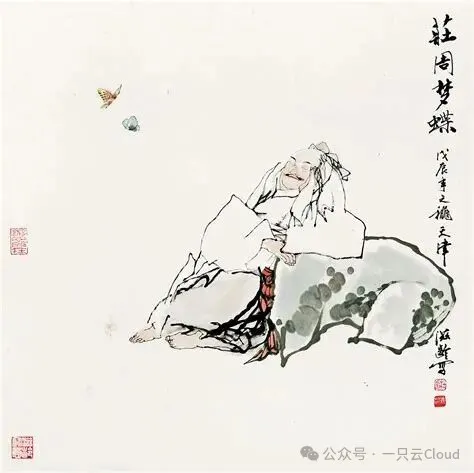
Once upon a time, I, Chuang Tzu, dreamt I was a butterfly, fluttering hither and thither, to all intents and purposes a butterfly. I was conscious only of following my fancies as a butterfly, and was unconscious of my individuality as a man. Suddenly, awaked, and there I lay, myself again. Now I do not know whether I was then a man dreaming I was a butterfly, or whether I am now a butterfly, dreaming I am a man. Between a man and a butterfly, there is necessarily a barrier. The transition is called Metempsychosis[1].
“Once, I, Zhuangzi, dreamed I was a butterfly, flying here and there, entirely a butterfly. Following my fancies, I knew myself as a butterfly and had no awareness of my individuality as a man. Suddenly I awoke to find myself lying there again. Now I do not know whether I was a man who dreamed of being a butterfly, or am a butterfly now dreaming of being a man. Between man and butterfly there must be a boundary. This change is metempsychosis…”
Introduction
The butterfly dream in Zhuangzi’s “Discussion on Making All Things Equal” is one of the most poetic parables in Chinese philosophy. By blurring the line between waking life and dream, Zhuangzi raises profound questions about what we can know to be real and what life itself is. The ninth-century missionary Herbert Giles introduced the story to Western readers, bringing it into a broader literary conversation. His emphasis on the “loss of individuality” and metempsychosis extended the parable’s philosophical reach.
In the twentieth century, Borges quoted and reworked the butterfly dream in his fiction, giving it new aesthetic and philosophical meanings. This essay considers that transformation on three levels: textual, literary, and philosophical.
Life as one great dream
In his Commentary on the Zhuangzi, Cheng Xuanying brings life and death into the story: it not only “places self and other within the transformation of things,” but also “entrusts life and death to the image of a dream” [2]. This concern is particularly clear in “Discussion on Making All Things Equal.” The distinction between dreaming and waking becomes a way of questioning the distinction between life and death. What ordinary people call dreaming and waking are only small dreams and small awakenings. We struggle through life convinced we are awake—but how do we know we are not inside a greater dream? To recognize life as a “great dream” is the “great awakening.”
Through the “transformation of things,” Zhuangzi joins dreaming and waking to life and death, making them part of the universe’s ceaseless changes. If life is a great dream, then living is a transformation of dreaming. Since life’s opposite is death, the transformation of a dream becomes equivalent to the transformation of death: dreaming temporarily suspends life, while death suspends it permanently.
This vision of the equality of things—where man and butterfly, dream and waking, life and death cease to be neatly separable—has made the butterfly dream a philosophical and aesthetic motif for readers across centuries and cultures. Its romantic feeling and reflections on life are difficult to leave behind.
If life really is a dream, the butterfly is its finest metaphor
Borges was fascinated, almost obsessed, with Zhuangzi’s butterfly dream. One of Latin America’s best-known writers, he believed Zhuangzi had created fantastic literature thousands of years earlier.
He offered a new translation and interpretation. While preserving the uncertainty about what is real, he deliberately played down the philosophy of the “transformation of things,” foregrounding instead the suspense of dreams and exchanged identities. (Comparing his retelling with Zhuangzi’s original is well worth doing. If I have time, I would love to explore it more carefully!)
Under the influence of the butterfly dream, Borges repeatedly used dreams to dissolve the boundary between fiction and reality. In This Craft of Verse, he observes: “If Chuang Tzu had dreamed he was a tiger, the metaphor would have meant nothing. A butterfly has something delicate and fleeting about it. If life really is a dream, the best metaphor to suggest it is a butterfly, not a tiger” [3].
The butterfly’s lightness and brief life are perfectly suited to the dreamlike quality of Borges’s work. It often leads him to an empiricist’s doubts: Is reality real? Can we trust what we perceive?
In Borges on Borges, he recalls how his father used an orange to prompt questions about perception and reality:
“Do you think the flavor of the orange belongs to the orange? If you close your eyes, if I turn out the light, what color is the orange?” [4]
This questioning of the truth of experience echoes Zhuangzi’s “he knew nothing of Zhou” (Zhuangzi, “Discussion on Making All Things Equal”). Little wonder that encountering Zhuangzi seems to have shaken Borges so deeply. The butterfly dream must have left a lasting impression.
Many of Borges’s recurring themes extend these questions. Again and again, his work suggests that the universe is only his dream—or, equally, that he is a dream of the universe. On a smaller scale, we readers may be a dream of Borges, and Borges may be a dream of ours.
Reader and writer, text and reality, fold into one another without beginning or end.
"¿Y sidormidos soñamos,
y sinuestro sueño esnuestro ser,
y sipor ese sueño vivimos,
morimos y soñando perduremos,
y si de nuestra vida son testigos
los grises gnomos que nos habitan,
y si son ellos los que viven
y somos nosotros las apariciones
que vagan por su claro laberinto?[5]"
and if our dream is our being,
and if by that dream we live,
we die and dreaming we endure,
and if of our life the witnesses are
the gray gnomes that inhabit us,
and if it is they who live
and we are the apparitions
who wander through their bright labyrinth?
Author’s note:
This essay began with an online comparison of Borges’s idea of “infinity” and Zhuangzi’s thinking about dreams. I love Latin American literature (mentioning that for the very first time, for the 23,587,799th time). A friend introduced me to Borges a few years ago, and he has had an enormous influence on me. Someone once suggested:
“Borges’s ideal readers are probably also enthusiasts of the philosophy of mind—enthusiasts, mind you; the experts may well look down on it.”
Exactly. That gets at why a rather superficial philosophy-of-mind enthusiast like me found that online discussion so compelling. I enjoy Zhuangzi, the absurd, existentialism, and different ways of thinking about life and death. In Zhuangzi, Kafka, and Borges alike, I catch glimpses of existential questions, and their thinking about the nature of the “real” resonates in remarkable ways. Setting out along seemingly distant cultural paths, they reach the same misty territory—the region I find most fascinating in human thought.
I’m getting carried away. I actually wrote this in a rush, trying to get my thoughts down as quickly as possible. The complete first draft alone ran to nearly 6,000 Chinese characters, so I will be sharing it in four or five installments. (The later posts will have more detail and a fuller treatment—and English versions, too!)
If I have time, I would also like to look more deeply at Borges’s rewriting of Zhuangzi and the act of re-creation in “Partial Magic of Don Quixote.” But that is for later.
Of course, since this post is called If Life Really Is a Dream [1]…
…I hope to join writers, poets, and philosophers from different eras in many more vividly colored “great dreams.”
I hope you come away from reading with something to keep or think about. 🙏❤️
May we think with Borges, wander freely with Zhuangzi, and find a spiritual home of our own in reading and reflection. Without clinging too tightly to the borders of reality, may we move through this great dream of life with freedom, ease, and lightness.
Work Cites
[1] Zhuangzi. Chuang Tzu: Mystic, Moralist, and Social Reformer. Translated by Herbert A. Giles, 2nd ed., Bernard Quaritch, 1926, p. 23.
[2] Cheng Xuanying. Commentary on the Zhuangzi. Quoted in Guo Qingfan’s Collected Commentaries on the Zhuangzi, Zhonghua Book Company, 1961.
[3] Borges, Jorge Luis. “The Riddle of Poetry.” This Craft of Verse, edited by Calin-Andrei Mihailescu, Harvard UP, 2000, pp. 75-76.
[4] Borges, Jorge Luis, and Nicomedes Suárez Gómez. “The Labyrinth of the Self.” Borges on Borges: Conversations with Nicomedes Suárez Gómez, edited by Nicomedes Suárez Gómez, translated by Ana María Hernández, New Directions, 2019, pp. 55-62.
[5] Borges, Jorge Luis. "The Gnomes." Selected Poems, translated by Robert Mezey, edited by Alexander Coleman, Penguin Books, 2000, pp. 78-79.
Zhou Rongsheng. “Borges’s Butterfly Dream: A Westerner’s ‘Chinese Dream.’” Comparative Literature and World Literature, 9 Sept. 2025, www.newdu.com/view.php?aid=65893.
Zhuangzi. Zhuangzi: The Essential Writings with Selections from Traditional Commentaries. Translated by Brook Ziporyn, Hackett Publishing Company, 2009.
Guo Qingfan. Collected Commentaries on the Zhuangzi. Edited by Wang Xiaoyu, Zhonghua Book Company, Beijing, 2004.
Wang Shumin. Collation and Commentary on the Zhuangzi, vol. 1. Institute of History and Philology, Academia Sinica, Taipei, 1988.