
Uncertainty: the essence of the fantastic
In 1970, the French theorist Tzvetan Todorov identified uncertainty as the essence of fantastic literature [6]. His Introduction à la littérature fantastique is a landmark in the study of the genre.
This idea captures the central attraction of Zhuangzi’s butterfly dream, and surely the quality that most captivated Borges: two narratives and two perspectives entwined. Is this a butterfly in Zhuang Zhou’s dream, or Zhuang Zhou in a butterfly’s? Or do Zhou and the butterfly remain distinct?
Borges understood this perfectly. He held that a fantastic story should end in a way that permits “both a supernatural and a natural explanation” [7].
The question at the heart of the butterfly dream forces the reader to waver between those two explanations.
Under the principle of fantasy—“following my fancies” [8]—Zhou is an incarnation of the butterfly, and the butterfly an incarnation of Zhou. Under the principle of reality—“my individuality as a man” [8]—Zhou is Zhou, and the butterfly is a butterfly.
The text’s uncertain phrases prevent readers from choosing. Through Borges’s selection, translation, invention, and commentary, readers are made to alternate between the worlds of these two principles, unable to settle in either. This produces the most intense effect of the fantastic as Todorov defines it [9], turning the butterfly dream into an exemplar of the genre for readers around the world.
For Borges, all theology and philosophy are forms of fantastic literature. Reality stands at one pole; at the other stand the ideas, substances, times, spaces, changes, and eternities conceived by philosophers.
The butterfly dream is more than a wistful observation that life resembles a dream. It questions existence, rebels against reality, and asks metaphysical questions about time and space.
Which pole is real? Or might both be entirely real?
The two twist together, at once this and that, producing a dreamlike uncertainty—the ideal condition of the fantastic [10]. This is the heart of Borges’s reading of the butterfly dream.
Borges is less interested in the final moral or the “transformation of things” than in drawing out the original’s aesthetic effect to its fullest. It is also why his work has been called “metaphysical fiction” [11].
In the mirror
There was a time when I was utterly obsessed with Borges. To me, his imagination exceeds even his prose; sometimes its beauty almost overwhelms the words. One of the remarkable things about his stories is how little space he needs to evoke a world as vast as the universe. That is why I have spent so much time and effort trying to make sense of even one elusive corner of it.
“If a man passed through Paradise in a dream, and was given a flower as proof that he had been there, and on waking found that flower in his hand… what then?” [12]
He is always startling us with dreams like this. Borges loved to dream. The countless dreams in his work left my younger self with endless things to imagine.
To borrow a comparison I found online: he dumps an enormous box of puzzle pieces in front of me, and I crouch on the floor, rummaging for the few key pieces that might give me a frame. After hours of work, exhausted and sweating, I discover that the puzzle has no edges. I have assembled a few scattered patches, enough for a vague impression, but I still have no idea what the picture is or where to go next.
In the current of interconnected dreams, Zhuangzi dreams of the butterfly, the butterfly dreams of Zhuangzi, a reader reads Zhuangzi, and Borges translates him. Within this stream of experience, where dream joins dream, neither Zhuangzi nor the butterfly exists as an individual. Zhou is only a passing trace in the butterfly’s dream; the butterfly is only a thought in Zhou’s. Each becomes the other’s dream. What we call reality is merely a pale inference made after waking; what we call existence has never been directly grasped. Everything is a dream, or something inside one.
In a dream there is neither subject nor object, neither past nor future. Time is not a rushing current but a still pool. The moments when Zhuangzi’s dream reappears in the waking world are, impossibly, the same moment—not a sequence of moments following one another.
A dream is proof that time can stand still, an interruption of passing itself. When Borges writes down the butterfly dream, Borges the writer does not exist, nor does Zhuangzi. Argentina is insubstantial, China is distant, and the 2,400 years between them vanish. All that exists is his dream of becoming Zhuangzi, who is dreaming of becoming a butterfly.
Dream within dream, one superimposed on another, overturns every law of reality, time, and space. In this moment, only imagination is allowed to stand.
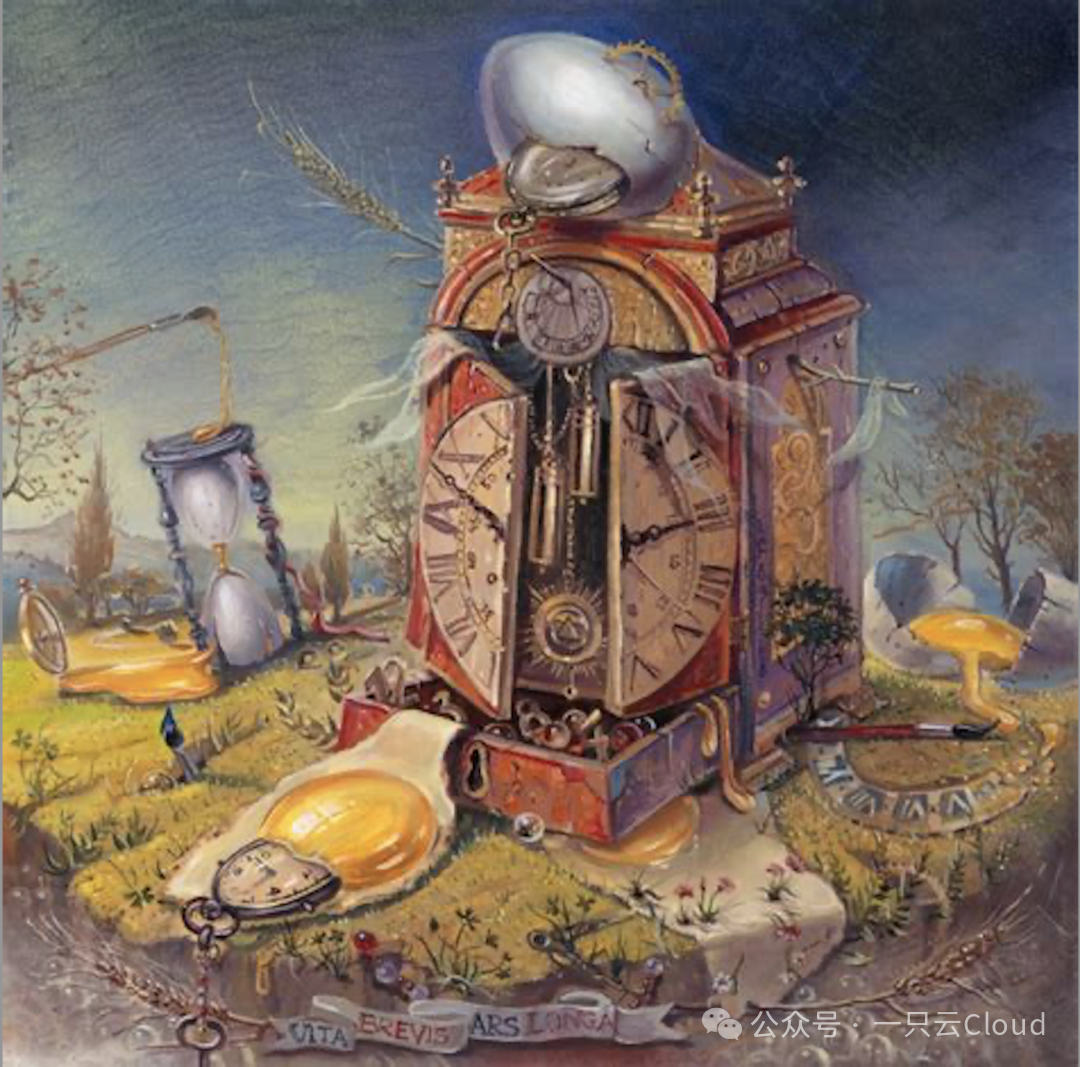
But at the end of “A New Refutation of Time,” Borges makes a complete 180-degree turn: “Time is the substance I am made of. Time is the river that sweeps me away, but I am the river; the tiger that tears me apart, but I am the tiger; the fire that consumes me, but I am the fire. The world, unfortunately, is real; I, unfortunately, am Borges” [13].
Reality reemerges here, delivering a firm answer to fantasy. He has to acknowledge that the subject exists, the object exists, space does extend, and history has never broken off. Doesn’t his retelling of the butterfly dream open just such an ambiguous territory for the reader? Fantasy and reality coexist here, each sustaining the other. This is the fantastic at its purest.
And so we keep assembling the puzzle and dreaming, without end, until we ourselves have become virtual.
Perhaps this terrifying emptiness explains Borges’s claim to be “timid,” and the deeper fear behind his reluctance to look into a mirror in “Partial Magic of Don Quixote” [14].
I understand why he was afraid of mirrors.
Work Cites
[6] Tzvetan Todorov, The Fantastic: A Structural Approach to a Literary Genre, trans. Richard Howard (Cleveland: Press of Case Western Reserve University, 1973), p. 25.
[7] Jorge Luis Borges, Other Inquisitions, trans. Ruth L. C. Simms (Austin: University of Texas Press, 1964), p. 115.
[8] The Complete Works of Chuang Tzu, trans. Burton Watson (New York: Columbia University Press, 1968), p. 49.
[9] Todorov, Tzvetan. The Fantastic: A Structural Approach to a Literary Genre. Translated by Richard Howard, Press of Case Western Reserve University, 1973.
[11] Emir Rodríguez Monegal, Jorge Luis Borges: A Literary Biography (New York: E. P. Dutton, 1978), p. 351.
[12] Borges, Jorge Luis. Dreamtigers. Translated by Mildred Boyer and Harold Morland, University of Texas Press, 1964.
[13] Borges, Jorge Luis. “A New Refutation of Time.” Complete Works: Essays (Volume 2), translated by Wang Yongnian and Lin Zhiwu, Shanghai Translation Publishing House, 2015, p. 487.
[14] Borges, Jorge Luis. “Partial Magic of Don Quixote.” Complete Works: Essays (Volume 1), translated by Wang Yongnian and Lin Zhiwu, Shanghai Translation Publishing House, 2015, p. 236.