
While reading Thomas Paine’s Common Sense recently, I noticed something interesting: he uses “she” and “her” to refer to British rule. He also capitalizes certain abstract concepts for emphasis.
 (A very loud page.)
I immediately took the question to teachers and professors I knew. It turns out that using “she” and “her” for countries, ships, cities, and abstract ideas is neither random nor a mistake. It is a long-established rhetorical device rooted in the traditions of personification and gender metaphor.
As for the capitals, they resemble the German rule that all nouns are capitalized.
In English, however, capitalization is selective and serves as emphasis. When Paine writes “Liberty,” “Government,” “Reason,” “Common Sense,” and “Tyranny,” he raises these concepts almost to the level of sacred truths or first principles.
Sometimes capitalizing an abstract concept also personifies it, making it an independent “character.” “Tyranny,” for instance, might become an evil despot, while “Liberty” becomes a goddess worth pursuing.
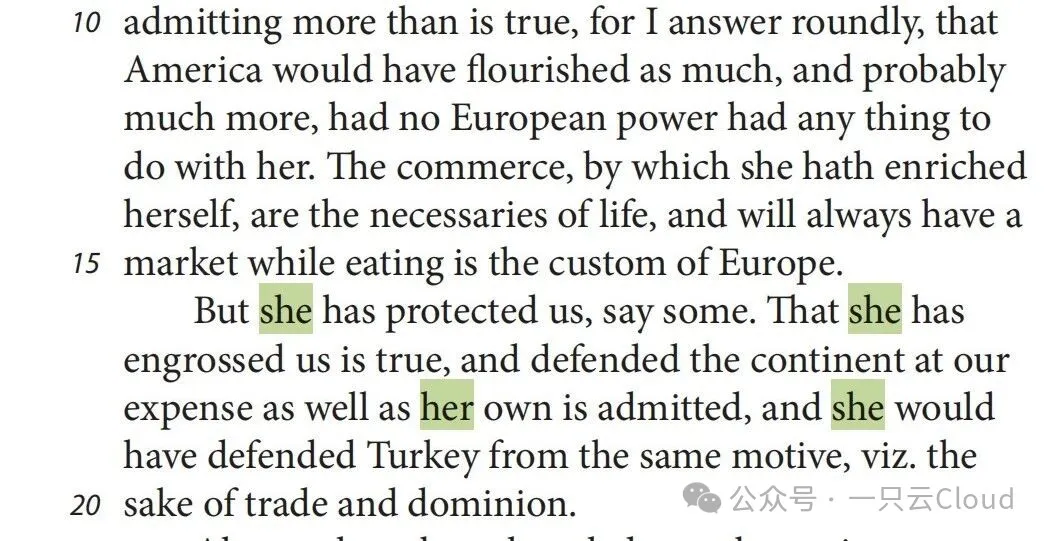 she-European power
I want to take this as a starting point for thinking about the power—and even the violence—of language. I also want to suggest some new angles from which to understand a mechanism that usually works beneath our notice:
Language is never neutral. It always bears the imprint of power structures and ideology.
[Oppression as lived experience]
"Hey! Throw like a girl! "
I began with a familiar phenomenon: using “she” or “her” for countries, ships, and abstract things. Its conventional definition is describing something inanimate as a feeling subject, making the expression more vivid and emotionally charged: personification and gender metaphor.
As far back as classical Latin and ancient Greek, nations and cities were called “mothers” or “goddesses.” English later inherited this maternal imagery.
Research suggests that referring to a country as “she” often draws on the symbol of the “motherland.” The nation becomes the mother who nurtures its citizens, and feminine pronouns express respect and affection [1]:
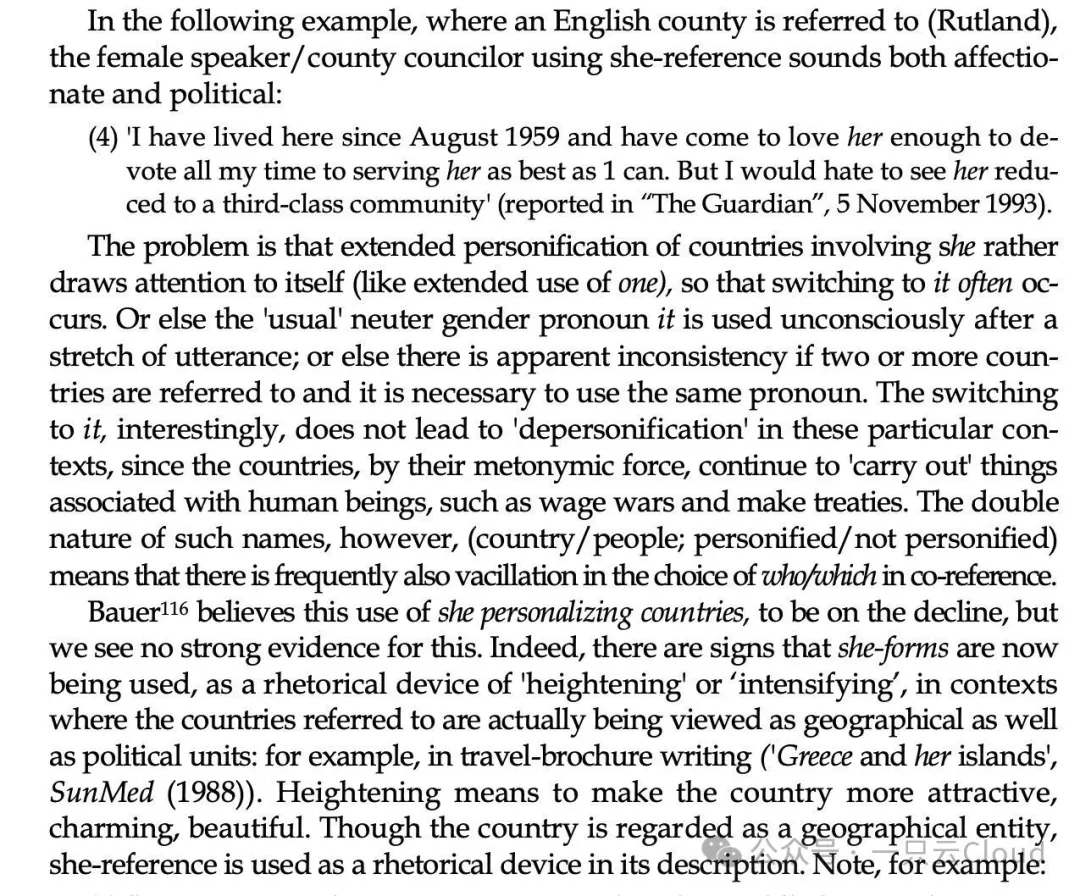 [1]
[1]
Feminine pronouns can therefore heighten the effect of a narrative in particular contexts.
In political speeches, for example, “she” and “her” can lend references to countries, cities, and territories a patriotic, solemn quality. Using “she” for abstractions such as freedom or a characteristic likewise gives them symbolic, personified form. Then there is the simplest case: expressing affection for something, as when we give a ship a special pronoun, much as we give names to inanimate objects.
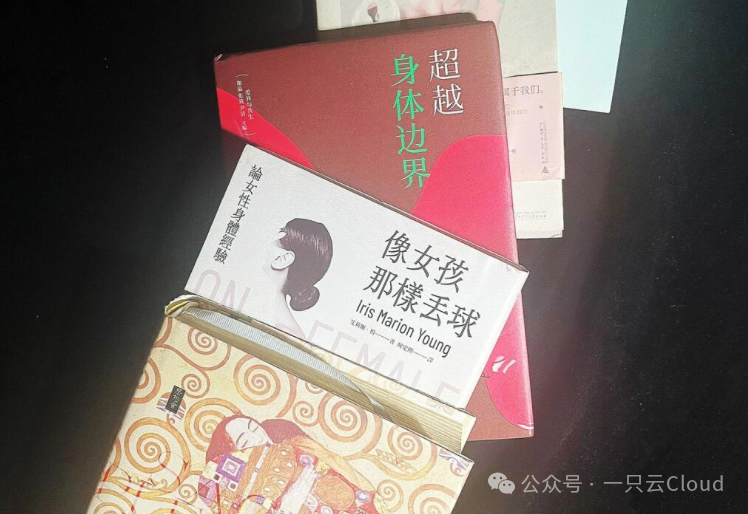
In a book I love, Throwing Like a Girl, Iris Marion Young also uses “she” and “her” in discussing the body, here to emphasize its objectification. (Please read it if you have the time!)
The feminine body is described as “both subject and object,” an instance of self-objectification. Under the gaze of social norms, the subject sees herself as an object for others, producing hesitation and a loss of force in her movements.
This sheds light on the hesitation, weakness, and self-objectification evoked by the opening command to “throw like a girl.” Without pronouns that already carry gendered meanings, the effect would be much weaker.
To me, this is a form of linguistic violence.
Foucault’s analysis of discourse and power, together with the phenomenology of the body—especially in Young’s book—helps me return to the place where this is actually experienced. From there, a question emerges: how is an individual’s gender identity defined, shaped, and contested in language? Let’s work through it.
[Discourse is practice]
First, I want to explain Foucault’s understanding of discourse: it is not the neutral expression of thought, but a practice that constructs reality and produces knowledge. Rules of discourse determine what can be said and how.
Capitalization suggests a useful starting point: whoever has the authority to capitalize a word can define the world’s central categories.
Capitalization can be an act of “consecration” and “possession.” It lifts an abstract concept out of ordinary vocabulary and grants it a sacred, absolute, unquestionable status. Historically, that authority first belonged to churches, monarchs, and Enlightenment thinkers—most of them men.
Returning to my example, when Paine capitalizes “Common Sense” and “Tyranny,” he is struggling for the right to define political reality. He wants readers to see this as no ordinary disagreement, but an elevated struggle between the absolute principles of Common Sense and Tyranny.
At some point, almost without our noticing, a whole system of gendered metaphors has taken shape in our minds: the active and ruling are male, the default; the passive and possessed are female, the marked exception.
Language, then, has always been a central site where power is constructed and contested.
Calling a country “she” appears to honor it, as in “motherland.” Yet its underlying logic places femininity and motherhood in the position of an object: something to be defined, protected, and fought over.
It works much like the female “self-objectification” I discussed through Throwing Like a Girl:
One objectifies the female body; the other objectifies an abstraction—a nation or a territory—through a feminine symbol.
The pairs female/male and woman/man offer another vivid example.
[A history covered over]
I recommend using “woman” rather than “female” in everyday speech because “female” can sound dehumanizing when used this way, and it carries a history of language that positions women beneath men.
“Woman” comes from the Old English wīfmann. Wīf meant a woman or adult female; it is the root of the modern “wife,” though its earlier meaning was broader.
Mann meant a person or human being. In Old English, it could refer to all people, with a prefix distinguishing gender. Literally, wīfmann meant “woman-person.”
Over time, the pronunciation of wīfmann merged into “woman.” The meaning of mann, meanwhile, narrowed to the male person. “Human” or “mankind”—the latter still centered on “man”—took over the general reference to humanity.
It is worth observing that Old English did not have a corresponding “male-person” compound of the same kind.
More specifically, Old English did not have an exclusively male-person word functioning just like the modern “man.” Its basic terms were female person (wīf/wīfmann) and person (mann), while male had a separate term, wer.
Feminist linguists therefore emphasize how men “appropriated” the label for the human—man—and made it their own, placing themselves in the position of humanity’s default representative and standard. Women were separated from the category of the human and made into “the other.”
What does this mean? At its origin, the core of “woman” was “person.” It acknowledged women as members of humanity. This helps explain why “man” feels ambiguous today and why using it for all humanity can be uncomfortable. At heart, it is an exclusive monopoly in language, produced through a history of inequality.
Although linguistic change reflects patriarchal social structures that make men the default representatives of humanity, “woman” itself leaves room for the struggle to be recognized as a complete person.
But when “female” is used as a noun to refer to a person, it strips away her social identity and individuality, giving her the dehumanized quality of a biological specimen. Compare the way we talk about animals:
“A female of the species.”
This habit of reducing women to their biological sex is a deep imprint of patriarchal thinking on language.
As a practice of discourse, “female” has an objectifying effect.
To put it more provocatively, “female” belongs to a scientific discourse of classifying and managing people. It constructs a “female” object that scientific knowledge can analyze and administer, rather than a subject with a will of her own.
This is why choosing our language carefully matters. Sadly, patriarchal oppression has drawn us into a “self-gaze,” and when we notice it, the response is often: “Could you stop being so sensitive?”
To return to discourse: language has real force. Consider “tribe.” When we refer to Western societies, we call them “nations”; African societies, meanwhile, are often described as “tribes.”
That apparently simple choice quietly places Western societies in the categories of the “modern” and the “civilized,” while assigning other societies to the “primitive” and the “traditional.” It reproduces the power relations of colonial discourse.
That is a large-scale example. But the same mechanism appears here:
“We have a new female in the department.” It may sound ordinary at first. Put it beside “We have a new woman in the department,” though, and the subtle difference becomes unmistakable.
How Language Shapes Gender and Power?

“The feminine is omitted from dictionaries, and women are disregarded in rights. The former contributes to the latter more than we imagine. Liberation through language should not be underestimated… The feminization of language has become urgent” [2].
Calling attention to language “making a fuss over nothing” is like accusing architects of fussing over bricks and mortar. Such comments themselves come from a gendered position. But even if we step outside that position, we can see that language is the basic material from which we build social reality, relationships, and self-understanding. If that material is skewed and biased, the whole structure built on it—our social assumptions—will be skewed too.
Dismissing these questions as “sensitivity” is precisely how power works: socially constructed oppression is disguised as “nature” or “normality,” encouraging those who experience it to stop questioning.
Similarly, saying “a person with a visual impairment” rather than using a derogatory label defines someone first as a person, instead of reducing them to a disability. Calling an adult woman a “woman,” rather than “a female,” respects her as a complete social person.
At its heart, attention to language is about recognition and dignity. Those are always large concerns, never trivial ones. Insisting on the name “woman” reclaims the experience of bodily subjectivity through language and corrects a distorted sense of what one’s body can do.
The newspaper La Voix des femmes, by using “le peuple souverains,” offers an example of a performative break with hegemonic discourse: changing the grammar forcibly brings women within the category of the “sovereign people.”
Even if it does not bother you personally, understanding why it matters to someone else—and why change can be meaningful—is enough.
[Closing thoughts]
A small observation while reading has led us into the workings of a language system. It helps me see that choosing “woman” and appropriate pronouns defends a world of social meaning, mutual recognition between subjects, and authentic bodily experience. I hope it has given you something to think about too. 🤓
The purpose of making language more precise and inclusive is not to condemn everyone who has used an older term. We want an environment where every girl, whether labeled “sensitive” or not, feels respected and included.
Language marks the boundaries of thought. Expanding language expands the possibilities of the world.
Work Cites
[1] Teterina, Marina, and Elena Crestianicov. “Personification or Sexification of Countries in English?” Dspace USARB, Alecu Russo State University of Bălți, 2012, pp. 102-09. JDspace, http://dspace.usarb.md:8080/jspui/bitstream/123456789/1518/1/p.102-109.PDF
[2] Le Radical. “L'Académie française et la langue.” Le Radical, 18 Apr. 1898.
Author’s note:
A week ago, a video by DuoLipa, a creator I really like, about going through brain fog reminded me of a prompt I had left untouched for more than a month. That night, I poured out 3,000 Chinese characters of thoughts about language and pronouns. I planned to fill in the reading gradually and turn it into a few posts, but I never found the time. Some of the ideas also felt too obscure—or too grand—to make sense on the page. (Really, I was struggling to explain them clearly.)
Then something struck me while reading recently, and I realized I could bring the ideas together. Two days later, this little darling of an essay was born. I hope I keep finding more and more fun ideas and concepts to write about! (Time permitting, haha.)
Writing it was a happy, comfortable process. It felt as though the things in my head were slowly coming into focus.
I hope you enjoy this piece as much as I do. Happy reading. ❤️