
Exploring how psychological and physiological states interact
How psychological and physiological states interact
As research into the human body advances, we are learning how acute anxiety speeds up the heartbeat through sympathetic activation, while cyclical changes in mood and skin reflect interactions with ovarian hormones.
Together, these experiences show that communication between our mental states and physical responses runs both ways, through pathways more complex than we once understood.
In recent years, more and more research has begun to lift the veil on how the body works. We know, for example, that intense anxiety can make the heart race, and that women may notice changes in their mood and skin around menstruation. These experiences suggest that psychological states and physical responses are far more closely connected than we might imagine.
The hypothalamic-pituitary-adrenal (HPA) axis plays an important role in this relationship.
The hypothalamic-pituitary-adrenal (HPA) axis plays an important part in maintaining the body’s internal balance and regulating the aging process.
This neuroendocrine system maintains hormonal balance through complex signaling pathways and feedback loops. To see how it works, let’s look at its main parts:
The HPA axis uses a complex series of signaling pathways and feedback mechanisms to maintain hormonal balance. Let’s first break it down into its main anatomical components:
1. The paraventricular nucleus (PVN) of the hypothalamus: at the base of the brain, beneath the third ventricle, with a direct neural connection to the pituitary.
2. The anterior pituitary: below the hypothalamus, regulated by hypothalamic releasing hormones carried through the hypophyseal portal system.
3. The adrenal cortex: above the kidneys, behind the peritoneum, divided into three zones that produce steroid hormones.
The paraventricular nucleus of the hypothalamus lies at the base of the brain, beneath the third ventricle, with a direct connection to the pituitary.
The anterior pituitary sits beneath the brain and is directly regulated by the hypothalamus.
The adrenal cortex lies above the kidneys in the retroperitoneal space.
Across these three regions, the body’s regulatory signals travel through two broad pathways: CRH and ACTH.
Across these three regions, the signals that regulate the body can be broadly divided into the CRH and ACTH pathways.
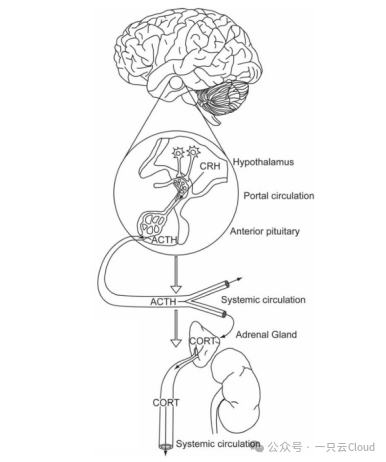
The process can be sketched like this:
Stress → Hypothalamus (CRH) → Pituitary (ACTH) → Adrenal glands (Cortisol) → Feedback inhibition.
Under stress, the CRH pathway begins in the hypothalamic paraventricular nucleus. It releases CRH, or corticotropin-releasing hormone, which reaches the anterior pituitary and prompts it to secrete ACTH, or adrenocorticotropic hormone. ACTH then travels through the bloodstream to the adrenal glands, promoting cortisol synthesis and release. Cortisol feeds back to inhibit CRH and ACTH secretion, helping maintain hormonal balance.
The HPA axis is therefore a primary stress-response system. It prompts physical adjustments that, in turn, affect mood and behavior.
Simply put, the HPA axis is a primary mechanism for responding to stress, and its activity brings about changes in mood and behavior.
A diagram of the signaling pathway:
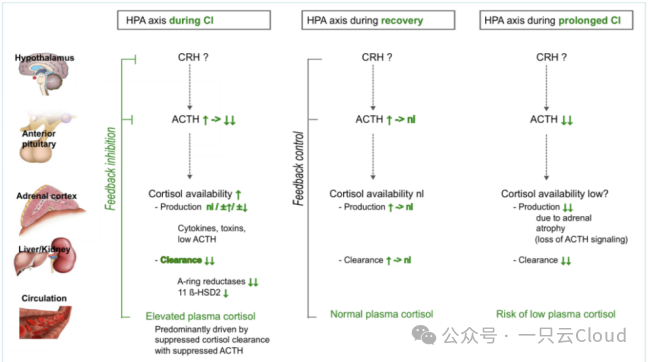
How does this affect the body? Cytokines are part of the answer. They support two-way communication, carrying inflammatory signals through the vagus nerve.
How does it produce these physical effects? To answer that, we need to understand the two-way communication of cytokines. They carry inflammatory signals through the vagus nerve. Acting as chemical messengers, cytokines affect the brain and produce “sickness behavior.”
As noted earlier, cortisol is the HPA axis’s main output. It acts through glucocorticoid receptors (GRs), both by influencing gene activity and through other mechanisms. It directly suppresses pro-inflammatory cytokines, including IL-1β, IL-6, and TNFα, and promotes anti-inflammatory cytokines such as IL-10 and TGFβ.
As mentioned above, the HPA axis’s main output is cortisol. Through genomic and non-genomic effects mediated by glucocorticoid receptors (GRs), cortisol directly suppresses pro-inflammatory cytokines such as IL-1β, IL-6, and TNFα, while promoting the activity of anti-inflammatory cytokines such as IL-10 and TGFβ.
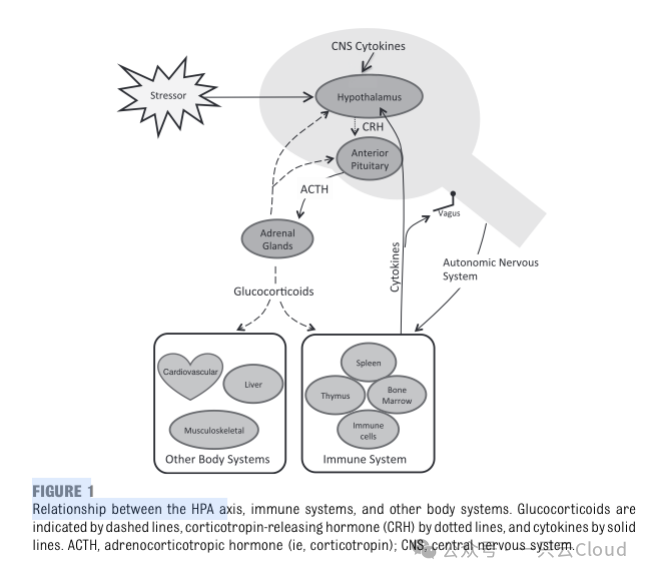
During inflammation, inflammatory mediators induce endothelial cells to express adhesion molecules (e.g., IL-1β, IL-6, TNF-α), facilitating cytokine passage across the blood-brain barrier (BBB). Vagus nerve terminals express IL-1 receptors that detect these cytokines. Once detected, the signal is relayed to the nucleus tractus solitarius (NTS), activating the PVN and HPA axis. The cortisol produced by the HPA axis then suppresses immune responses, creating a negative feedback loop. This illustrates the two-way nature of a process that ultimately affects multiple organ systems.
When the body is inflamed, inflammation induces endothelial cells to express cell adhesion molecules (CAMs), helping cytokines cross the blood-brain barrier (BBB) and reach IL-1 receptors at vagus nerve endings.
After cytokine signals are detected, information passes to the nucleus tractus solitarius (NTS), activating the hypothalamic paraventricular nucleus (PVN) and the HPA axis. Cortisol produced by the HPA axis then suppresses the immune response, completing a negative feedback loop. Neurotransmitters such as norepinephrine and acetylcholine also regulate cytokine production. The process is therefore bidirectional, with effects that reach the body’s various organs.
A diagram makes these connections easier to follow:
Does that sound complicated? This diagram shows the relationship between the HPA axis, the immune system, and other bodily systems, making the pathways easier to follow.
Alongside the HPA axis’s activating pathways, we need to consider what happens when its negative feedback goes wrong. A substantial body of evidence links HPA dysfunction with conditions including depression and anxiety.
Alongside the HPA axis’s activating circuits, we also need to consider disruptions in its negative feedback. Research closely links HPA dysfunction with psychiatric conditions such as depression and anxiety.
What is cortisol?
We keep talking about cortisol, one of the HPA axis’s products. What is it?
Cortisol is a stress hormone. An imbalance in the HPA axis therefore disrupts cortisol secretion. High cortisol weakens the function of immune cells such as T cells and reduces immune defenses. In other words, cortisol creates a negative feedback loop that dampens both HPA activity and inflammation.
Cortisol is a stress hormone. HPA imbalance therefore brings disordered cortisol secretion. High cortisol weakens immune cells such as T cells and reduces immune defenses. Cortisol from the HPA axis creates a negative feedback loop that dampens HPA activity and inflammation. (One major consequence of chronic stress early in life is HPA dysregulation while the neuroendocrine system is still developing.) A lasting cortisol imbalance can trigger or worsen physical conditions such as rheumatoid arthritis.
Although the brain and immune system are physically separate, cytokines connect them as chemical messengers. They play a crucial role in both innate and acquired immunity, helping explain how these hormones affect the body.
Although the brain and immune system are physically separate, cytokines connect them as chemical messengers and play a key role in both innate and acquired immunity. This helps explain how these hormones affect the body. When faced with an immune threat, the immune system produces pro-inflammatory cytokines to combat it. These cytokines also act directly on the brain, contributing to loss of appetite, fatigue, social withdrawal, and low mood. That brings us back to the experiences at the beginning: anxiety can come with a racing heart, low energy, poor appetite, and even skin problems.
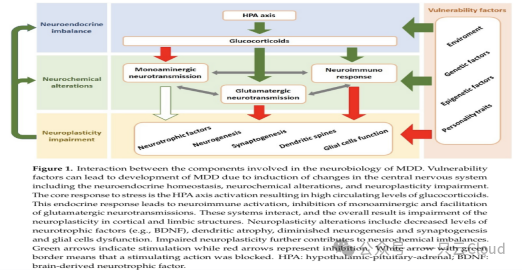
The HPA axis plays a part in many bodily functions. This chart shows how, by regulating neurotransmitters and immune responses, it influences the brain’s capacity to change—its neuroplasticity.
The HPA axis thus plays a role in many physiological functions. This chart shows in detail how it influences neuroplasticity by regulating neurotransmitters and immune responses, ultimately producing a range of physical and psychological changes.
Unusual changes in the nervous system can cause problems in many parts of the body. See the diagram below:
Unusual changes in the nervous system can cause different problems throughout the body. Take a look at the following diagram:
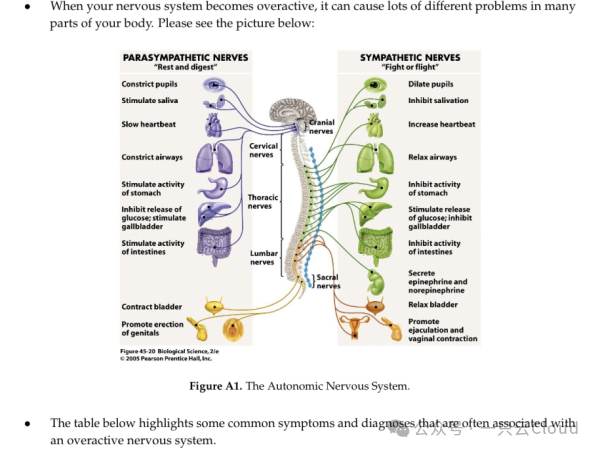
In the United States, more than 50% of people have chronic diseases linked to HPA axis dysfunction. These conditions also contribute to the processes underlying depression, behavioral disorders, and post-traumatic stress symptoms in both adults and children.
In the United States, more than 50% of people have chronic conditions associated with HPA axis dysfunction, including low testosterone, estrogen imbalance, metabolic syndrome, and cardiovascular disease. These conditions also contribute to the pathophysiology of depression, behavioral dysregulation, and post-traumatic stress symptoms in adults and children.
Let’s look briefly at cytokine storms and neuroimmune imbalance in two clinical conditions:
Let’s connect this discussion to real conditions by looking at cytokine storms and neuroimmune dysregulation in two clinical states:
1. Depression: Patients have higher serum levels of IL-6 and TNFα and fewer glucocorticoid receptors in the hippocampus, causing the HPA axis’s negative feedback to fail.
1. Depression: Patients show increased serum IL-6 and TNFα, alongside downregulation of glucocorticoid receptors in the hippocampus, causing the HPA axis’s negative feedback to fail.
2. Post-traumatic stress disorder (PTSD): Pro-inflammatory factors strengthen fear memories by increasing amygdala activity, while the prefrontal cortex becomes less able to inhibit that response.
2. Post-traumatic stress disorder (PTSD): Pro-inflammatory factors intensify fear memories by increasing amygdala activity while impairing the prefrontal cortex’s inhibitory function.
Stable cortisol secretion is therefore important for both mental and physical well-being.
Keeping cortisol secretion “stable” is therefore important for both mental and physical well-being.
Stress responses cannot be avoided entirely. So let’s get practical: here are a few ways to ease these symptoms.
Time for something practical. We cannot entirely avoid stress responses—whether anxiety before an exam, fluctuations in estrogen and progesterone around menstruation, or changes in neurotransmitters such as serotonin. We can, however, take steps to ease their effects:
1. Reduce caffeine intake. Caffeine increases the effects of norepinephrine and dopamine. After consuming it, cortisol and adrenaline levels may double.
2. Maintain a healthy lifestyle and make time for aerobic exercise every day—even if it is only half an hour.
3. If you notice difficulties with your mental state, seek help promptly from a doctor or teacher.
1. Reduce caffeine intake. Caffeine increases the effects of norepinephrine and dopamine and blocks adenosine receptors, disrupting sleep cycles and making it harder to fall asleep. Over time, this can contribute to chronic fatigue and reduced cognitive function; abruptly stopping can cause withdrawal symptoms such as headaches, tiredness, and difficulty concentrating. Cortisol and adrenaline levels may double after caffeine consumption, and short-term effects can persist even with tolerance.
2. Maintain a healthy lifestyle and make time for aerobic exercise every day, even if it is only half an hour.
3. If you notice difficulties with your mental state, seek help promptly from a doctor or teacher.
References:
1. On the Neuroendocrinopathy of Critical Illness: Perspectives for Feeding and Novel Treatments
https://lirias.kuleuven.be/bitstream/123456789/551706/3/post_AJRCCM_Mar_2016_Van_den_Berghe.pdf
2. The Regulatory Response of the Hypothalamus-Pituitary-Adrenal Cortex Stress Response
https://europepmc.org/articles/pmc4074672?pdf=render
3. Receptor Signaling in Stress and Depression
https://www.mdpi.com/1422-0067/20/11/2778/pdf
4. Research on the Mechanism of Stress on Immune Function: https://m.yisbei.com/literature/detail/id/9635.html